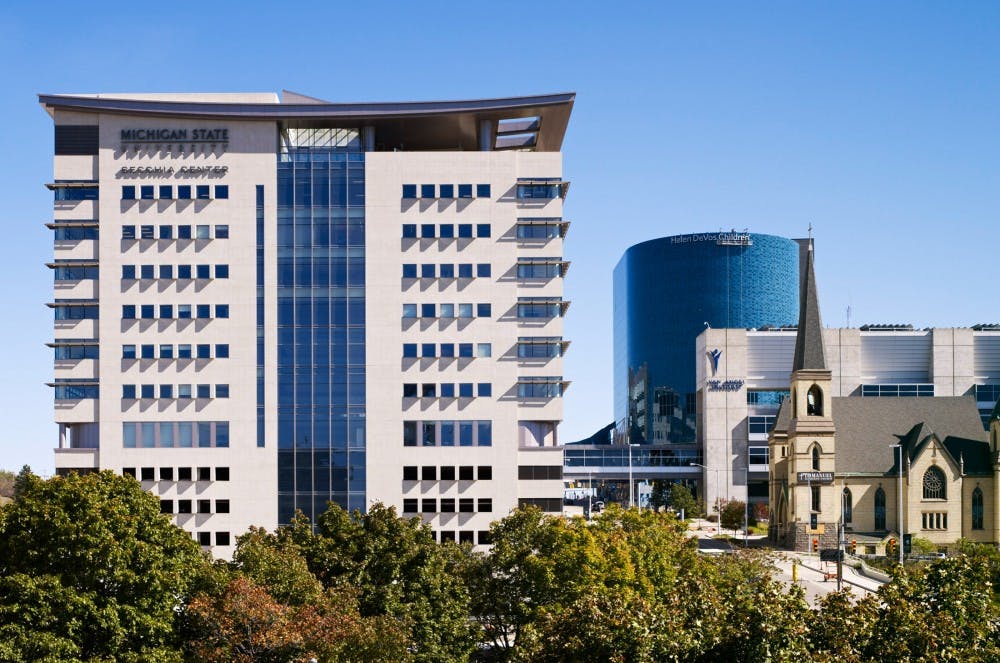
The College of Human Medicine’s Secchia Center has been honored for its efforts to “go green” in Grand Rapids.
Last week, the Secchia Center — the college’s headquarters in Grand Rapids — was awarded Leadership in Energy and Environmental Design, or LEED, gold certification by the U.S. Green Building Council. The building is the only MSU building aside from the Surplus Store and Recycling Center to earn gold certification — the second-highest LEED ranking.
Although the building is not physically located on the East Lansing campus, environmental stewardship is a focus of any MSU construction project, said Jennifer Battle, assistant director for campus sustainability.
“Even though the Secchia Center’s not using energy from our power plant, it’s using energy from somewhere,” she said. “Even though it’s in Grand Rapids, having the Secchia Center be LEED certified is an extension of our values.”
The building is projected to save about $45,000 per year in electricity rates because of its sustainable technology, said Elizabeth Lawrence, assistant dean for the College of Human Medicine.
Achieving the gold certification was a team effort among the college and the design and construction teams, and some of the LEED requirements, such as using materials that have low volatile organic compound — or VOC — emissions, make the space a better area for students and faculty, she said.
“It’s a healthier place to study and to work,” Lawrence said.
LEED awards are based on six different categories, including sustainable sites, water efficiency, indoor environmental quality and energy and atmosphere, said Douglas Norton, project executive for The Christman Co. — the construction manager for the Secchia Center.
The construction team was able to recycle or reclaim just less than 60 percent of all construction waste, he said, and about 40 percent of all building materials were manufactured by regional companies.
Inside the building, the energy savings also should be racking up during the building’s life cycle, he said.
“We were able to use efficient equipment and technologies that resulted in a projected energy use (reduction) of 34 percent,” Norton said, adding that part of the power for the building comes from wind-generated electricity.
The Secchia Center also is located near bus routes and has bicycle storage space and changing rooms, he said.
Grand Rapids has about 72 LEED-certified buildings and there are about 140 total in west Michigan, said Renae Hesselink, chairwoman of the U.S. Green Building Council West Michigan Chapter, in an email.
Earning LEED certification today is easier than five years ago, but earning gold certification requires creativity from building owners, she said.
“Today, LEED silver is sort of becoming very achievable and gold is a step up from that,” Hesselink said. “The LEED standard continues to evolve and goes through changes about every two years, and each time it changes the bar is raised as products and technologies become more readily available and cost-effective or cost-neutral.”
Support student media!
Please consider donating to The State News and help fund the future of journalism.
Discussion
Share and discuss “College of Human Medicine HQ earns ‘green’ certification” on social media.