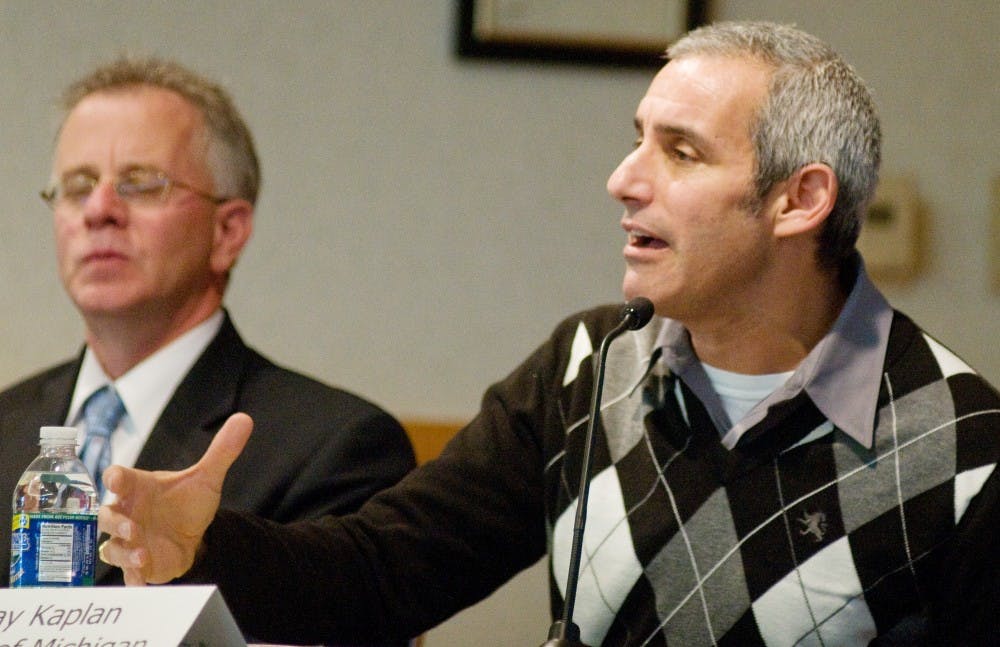
A panel of four law and policy experts with corporate and academic ties spoke out against a series of proposed bills that target LBGT benefits Tuesday afternoon at an MSU College of Law forum.
The bills — three of which sit in the Michigan House of Representatives and one of which sits in the Michigan Senate — would severely cut benefits of public employees and their domestic partners, among other things.
MSU currently offers benefits to both same-sex and married couples.
Those moves could impact MSU faculty and staff, and LBGT advocacy groups on campus have spoken out against the bills in the past month.
Bart Feinbaum, a panel guest and the principal counsel for labor and employment law at health care provider Blue Cross Blue Shield of Michigan, said two of the bills could lead to a “mass exodus” of employees at Michigan universities.
The bills would prevent public employees and their domestic partners from receiving medical and other benefits, which would leave some families struggling to make ends meet, he said.
“I’m sure the same thing could happen at MSU,” he told a group of about 40 students, faculty and staff in the College of Law’s Castle Board Room.
Rep. Dave Agema, R-Grandville — who sponsored the bill that would cut domestic partner benefits — told The State News in a previous interview the bill would not discriminate against LBGT employees in the state and instead simply would protect laws prohibiting same-sex marriage.
“I’ve got the law on my side,” he said.
Feinbaum and other panel members — including MSU College of Law professor Nancy Costello — argued against the legislation, saying it does not make sense for the state to get involved with university benefit practices.
Blue Cross Blue Shield will continue to offer same-sex benefits no matter what the
legislature decides, Feinbaum said.
“We want our company to be known as progressive,” he said.
Second-year law student Lindsey Schuler, who attended the forum, said above all else, she appreciated Feinbaum’s corporate insight into how employers might respond to discriminatory legislation.
“That is a very real issue — especially with the unemployment rate in Michigan right now,” Schuler said.
Another bill sitting in the House would exclude sexual orientation or gender identity from discrimination protection under the Elliott-Larsen Civil Rights Act.
Michigan’s legislature is attempting to micromanage universities by restricting the benefits they provide, said Jay Kaplan, a staff attorney for the LGBT Project of the American Civil Liberties Union of Michigan.
“These legislators are very serious,” Kaplan said. “They are moving forward with this.”
The fourth bill which drew contention from the panel centers around students involved in psychology or counseling programs.
Under the proposed law, students in those programs could refuse to provide service to people depending on whether or not their client’s views violate their religious or moral beliefs.
Each of the four bills are further examples of the state of Michigan’s bias against certain groups, Costello said.
Support student media!
Please consider donating to The State News and help fund the future of journalism.
“All of the sudden, the state is going to step away and say, ‘We’re not going to offer these benefits,’” she said.
Discussion
Share and discuss “Forum critiques pending LBGT-targeted legislation” on social media.