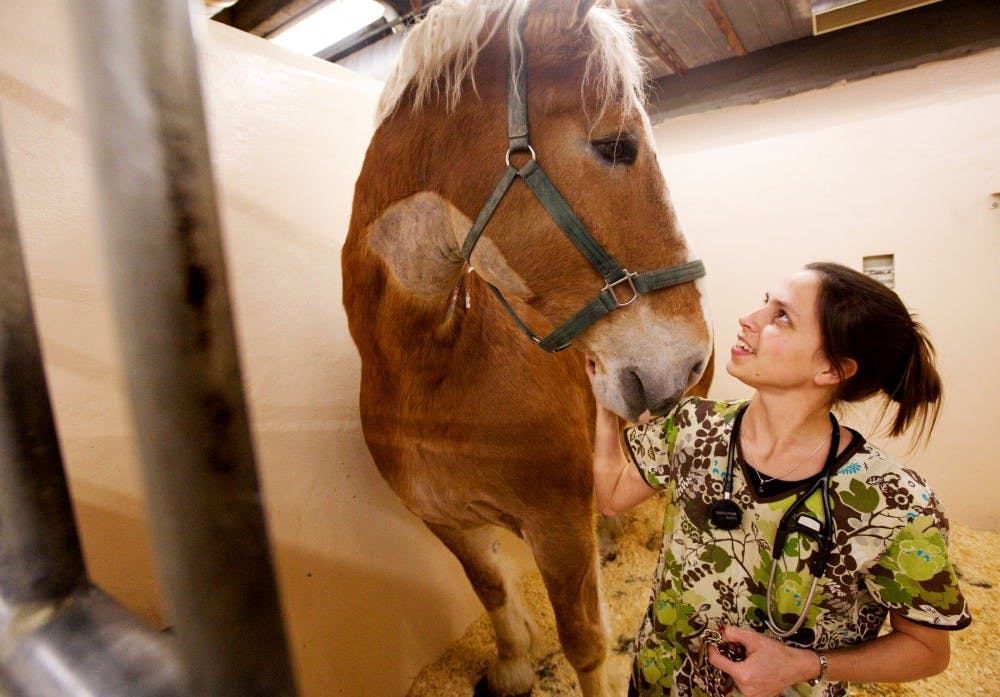
Since Julie Rapson was a child growing up on her family’s horse farm, she has dreamed of becoming an equine veterinarian.
The MSU Equine Club president and second-year veterinary student is part of a minority in the world of veterinary students, as she is hoping to hold a position as a large animal veterinarian who specifically works with horses after graduating.
According to an article from Inside Higher Ed, some universities have been pushing to expand their large animal veterinary programs to meet the high demand some towns currently have for the veterinarians.
Raymond Geor, professor and chairman of MSU’s Department of Large Animal Clinical Sciences, said more students are focused on small or companion animal practice in MSU’s College of Veterinary Medicine than large animal practice, but all students in the college still are capable of working in a variety of fields after graduation.
The number of students interested in the large animal veterinary science field has been fairly consistent during the past few years, but MSU has been working to develop programs that focus on a variety of areas within the large animal field, which includes dealing with horses and cows, Geor said.
“Veterinarians do change their direction quite frequently in their careers,” Geor said. “We are preparing students for a variety of positions.”
MSU’s veterinary medicine college is the only one in the state and one of eight at Big Ten universities, including the University of Illinois and Ohio State University.
The Department of Large Animal Clinical Sciences allows students interested in large animal science to work in the Veterinary Teaching Hospital on campus or a training center for dairy professionals located in Green Meadow Farms in Elsie, Mich., Geor said.
Students also can work with the Practice-Based Ambulatory Program, which assigns students to spend three weeks in another large animal practice in Michigan, he said.
When veterinary students work in the clinic, they are required to work in both the Small Animal Clinic and Large Animal Clinic, said Pat LeBlanc, Director of the Veterinary Teaching Hospital.
LeBlanc said he has seen a greater interest in the small animal field in the college, which might be attributed to the majority of students being women, but there still is strong interest in the large animal program by many students. The college accepts about 100 students each year, he said.
“We have to provide a broad-based education for all of the veterinary graduates,” LeBlanc said.
“Students with a large (animal) interest can take extra rotations in the large animal clinic.”
Rapson said she particularly likes visiting the Large Animal Hospital because it helps her apply the information she is learning in class.
“It is really important when all you’re doing is studying so much … to go down to the clinic and see the live animals and not just read out of the books,” Rapson said.
Support student media!
Please consider donating to The State News and help fund the future of journalism.
Discussion
Share and discuss “MSU meets demand for large animal sciences” on social media.