As smart phones and portable technology become more of a norm among younger populations, new distractions for drivers are on the rise.
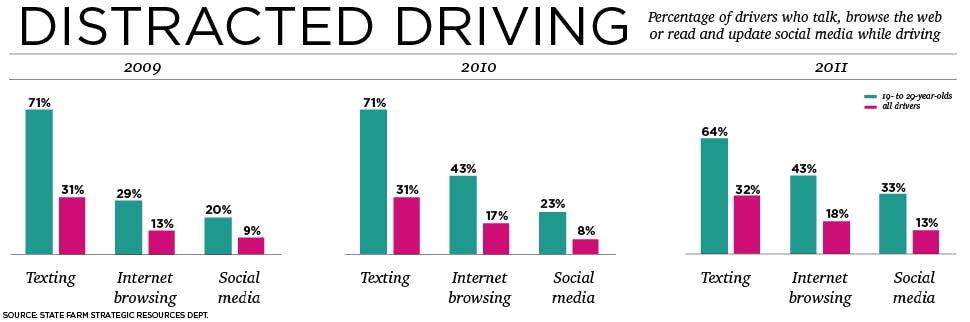
For drivers ages 18-29, accessing the Internet from a cell phone while driving increased 14 percent from 29 percent in 2009 to 43 percent in 2011, according to a national survey of about 1,000 drivers. The survey was conducted by State Farm Insurance released December 2011.
Checking social media networks such as Facebook and Twitter while driving also increased, rising 16 percent in the 18-29 age group from 21 percent in 2009 to 37 percent in 2011, according to the survey.
Texting while driving among 18- to 29-year-olds dropped 7 percent in that time frame, from 71 percent to 64 percent — a change that could be in part because of laws signed by Michigan and other states to officially ban the practice, State Farm spokeswoman Angie Rinock said.
“That definitely is one deterrent, to have an actual law saying, ‘You can’t do this,’” she said.
The rise of social media and Internet use while driving, especially among younger drivers, could be linked to increased cell phone use and connectivity in modern communication, Rinock said.
“It being a major part of their life and how they communicate socially makes the temptation higher,” Rinock said.
A higher amount of social media usage in drivers is not surprising, considering the increase in technology advancements and more accessible smart phones, MSU police Lt. Randy Holton said.
“As more technology is made available, you always have that possibility of it being used in a car and having a distracted driver,” Holton said.
“MSU is no different than any other place, but we have a lot of the age group that uses more texting.”
East Lansing police Capt. Bill Mitchell said the city’s police don’t write many tickets for texting and driving, but that doesn’t necessarily mean the problem has stopped.
“It’s kind of hard to enforce and to catch,” Mitchell said.
Because of enforcement difficulties, more restrictive rules pertaining to distracted driving might not be as effective to young drivers, professional writing junior Kaitlyn Canary said.
“A lot of times, people are only really concerned if they’re going to get caught,” Canary said.
Mitchell said it should be second nature for drivers to keep distractions such as texting, checking social media, talking on cell phones and others out of the picture, but tighter laws might be the best reminder for people so larger consequences aren’t suffered.
“It’s unfortunate we even have to think about having laws like that,” Mitchell said. “It seems ridiculous — it seems like that would be a no-brainer, but we’re all guilty.”
Support student media!
Please consider donating to The State News and help fund the future of journalism.
Discussion
Share and discuss “Smart phones lead to more driving distractions” on social media.